Have you noticed that your front teeth appear to lean or tilt forward? If your upper or lower front teeth seem more prominent than usual, you may have proclined teeth.
Tooth proclination can affect the appearance of your smile and, in some cases, may be associated with bite problems, difficulty closing the lips comfortably, or increased risk of trauma to prominent front teeth.
Understanding why teeth become proclined is the first step toward identifying the right treatment.
At Anbu Dental Clinic, Madurai, our dental team evaluates tooth alignment, jaw relationships, bite, and other contributing factors before recommending an appropriate treatment plan.
What Are Proclined Teeth?
Proclined teeth are teeth that are tilted or positioned more forward than their ideal alignment. The term is commonly used when the front teeth, particularly the upper incisors, appear to lean outward.
Proclination can occur in the upper teeth, lower teeth, or both.
Some common signs include:
- Upper front teeth appearing pushed forward
- Front teeth that look unusually prominent
- Difficulty keeping the lips comfortably closed
- Increased spacing between some teeth
- An overjet, where the upper front teeth extend significantly ahead of the lower teeth
- Changes in the appearance of the facial profile
- Bite-related concerns
The appearance and severity of proclination can vary considerably from person to person.
Why Do Teeth Become Proclined?
There isn’t always a single reason for proclined teeth. Several factors can contribute to their position.
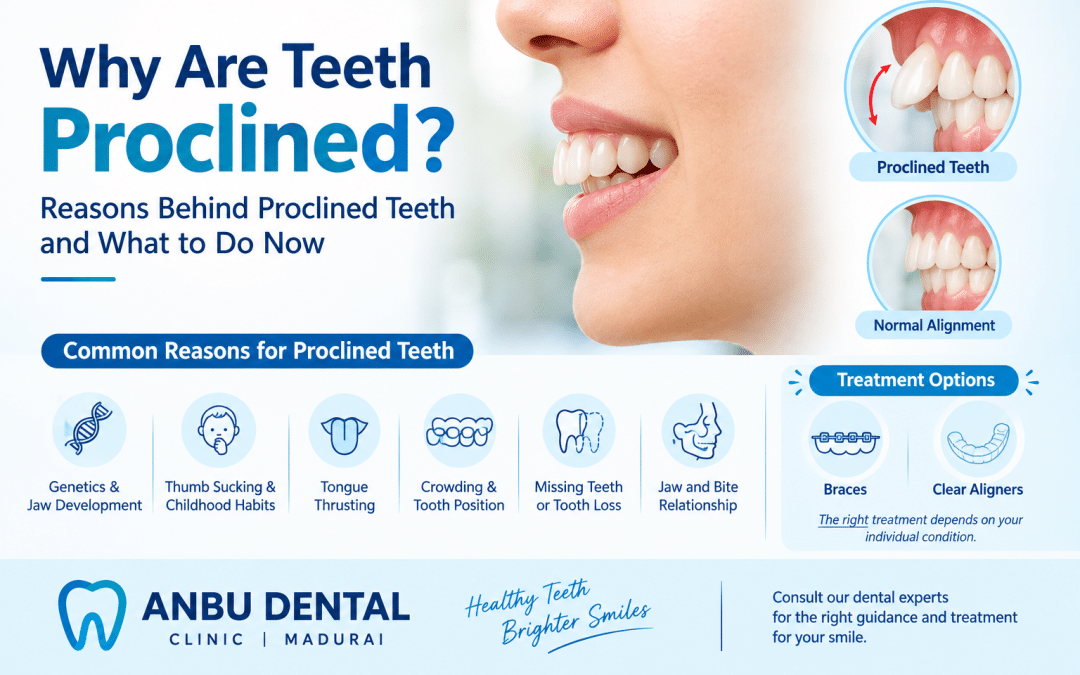
1. Genetics and Jaw Development
Genetics can influence the size and shape of the jaws, the position of the teeth, facial growth, and the relationship between the upper and lower jaws.
Some people naturally develop a dental or skeletal pattern in which the front teeth appear more forward.
2. Thumb Sucking and Other Childhood Habits
Prolonged thumb sucking or pacifier use during childhood can influence the developing teeth and jaws.
Depending on the duration, frequency, and intensity of the habit, these behaviours may contribute to changes in the position of the front teeth and bite.
3. Tongue Thrusting
A tongue thrust occurs when the tongue pushes forward against or between the teeth during swallowing or at rest.
Persistent abnormal tongue pressure can contribute to certain types of tooth displacement and bite problems.
4. Crowding and Tooth Position
The way teeth fit within the available space in the jaw can influence their inclination.
In some cases, teeth may become more forward-positioned as they adapt to limited space or an existing bite pattern.
5. Missing Teeth or Tooth Loss
Missing teeth can change the way the remaining teeth are positioned.
Over time, neighbouring teeth may shift or tilt into available spaces, potentially affecting overall dental alignment.
6. Jaw and Bite Relationship
Sometimes the appearance of protruding or proclined teeth is related not only to the teeth themselves but also to the relationship between the upper and lower jaws.
An orthodontic assessment is important to determine whether the concern is primarily dental, skeletal, or a combination of both.
Can Proclined Teeth Affect Your Smile?
Yes. Proclined front teeth can change the appearance of the smile and facial profile.
Depending on the severity, they may make the front teeth look more prominent or affect the way the lips come together.
However, having slightly forward-positioned teeth does not necessarily mean that treatment is required. The need for treatment depends on factors such as dental health, bite, function, aesthetics, and the individual’s goals.
Can Proclined Teeth Affect Your Bite?
In some cases, proclination can be associated with an increased overjet or other bite problems.
An increased overjet means the upper front teeth extend further forward relative to the lower front teeth.
A dental professional can assess your bite to determine whether the tooth position is affecting chewing, speech, lip function, or other aspects of oral health.
What Should You Do If Your Teeth Are Proclined?
If you notice that your front teeth are becoming increasingly prominent, don’t try to correct them yourself.
The first step is a dental and orthodontic evaluation.
During the consultation, the dentist may assess:
- Tooth alignment
- Overjet and overbite
- Jaw relationship
- Facial profile
- Available space for the teeth
- Gum and bone health
- Previous orthodontic treatment
- Childhood oral habits
- Overall oral health
Dental photographs, X-rays, digital scans, or other diagnostic records may be recommended when necessary.
How Are Proclined Teeth Treated?
Treatment depends on the underlying cause and severity of the proclination.
Orthodontic Treatment
Braces are commonly used to correct tooth alignment and control the position of the teeth.
Depending on the case, treatment may involve traditional metal braces or other orthodontic options.
Clear Aligners
For selected cases, clear aligners may be considered to gradually move teeth into a more appropriate position.
However, clear aligners are not suitable for every case of proclined teeth. A professional assessment is necessary to determine whether they can achieve the desired tooth movement.
Treatment of Oral Habits
If a persistent childhood habit or abnormal tongue function is contributing to the problem, addressing the underlying habit may form part of the treatment plan.
Simply moving the teeth without addressing a contributing habit may increase the risk of the teeth moving again after treatment.
Treatment for Complex Jaw Problems
When significant jaw-position differences contribute to the appearance of protruding teeth, orthodontic treatment may need to be planned according to the underlying skeletal relationship.
In more complex cases, an orthodontist may discuss additional treatment options.
Can Proclined Teeth Be Corrected Without Braces?
It depends on the cause and severity.
Some mild alignment concerns may be managed with clear aligners or other conservative orthodontic approaches. However, there is no single treatment that works for every patient.
Avoid attempting DIY teeth-straightening methods or applying pressure to your teeth at home. Tooth movement should be planned and monitored by a qualified dental professional to protect the teeth, gums, and supporting bone.
What Happens If Proclined Teeth Are Left Untreated?
Not every case of proclined teeth requires treatment.
However, significant protrusion may sometimes be associated with:
- Increased risk of trauma to prominent front teeth
- Bite problems
- Difficulty with lip closure
- Tooth wear in some cases
- Difficulty maintaining oral hygiene in certain areas
- Concerns about smile or facial appearance
A dental evaluation can help determine whether treatment is actually necessary.
Why Early Evaluation Can Be Helpful
If proclined teeth are identified during childhood or adolescence, an early orthodontic assessment can help evaluate the developing bite and jaw relationship.
Early evaluation does not necessarily mean immediate treatment. In some cases, the dentist or orthodontist may simply recommend monitoring the growth and development.
For adults, orthodontic treatment can also be considered depending on the condition of the teeth, gums, bone support, and bite.
Frequently Asked Questions About Proclined Teeth
1. Why are my front teeth sticking out?
Forward-positioned front teeth can result from genetics, jaw development, oral habits, tongue thrusting, crowding, or the relationship between the upper and lower jaws. A dental examination is required to identify the specific cause.
2. Can proclined teeth be corrected?
Yes, many cases of proclined teeth can be managed with orthodontic treatment. The appropriate approach depends on the severity and underlying cause.
3. Can braces correct protruding front teeth?
Braces can correct many types of tooth-position and bite problems, including certain cases involving prominent or proclined front teeth.
4. Can clear aligners fix proclined teeth?
Clear aligners can correct certain cases of tooth proclination, but suitability depends on the amount and type of tooth movement required.
5. Are proclined teeth dangerous?
Proclined teeth are not necessarily dangerous. However, significantly prominent front teeth may have a higher risk of trauma, and some cases may be associated with bite or functional concerns.
6. Should I see a dentist if my teeth are proclined?
Yes. If you are concerned about prominent or forward-tilted teeth, a dental consultation can help determine whether treatment is needed and what options may be appropriate.
Proclined Teeth Treatment in Madurai
If you are concerned about proclined teeth, protruding front teeth, crooked teeth, or an increased overjet, consult a dental professional for an evaluation.
At Anbu Dental Clinic, Madurai, our dental team can assess your teeth and bite and help you understand suitable treatment options, including orthodontic treatment, braces, and clear aligners, when appropriate.
If you are searching for proclined teeth treatment in Madurai, orthodontic treatment in Madurai, braces for protruding teeth, or clear aligners in Madurai, a professional dental assessment is the right place to start.
Anbu Dental Clinic – Madurai
Consult a dental professional to understand the cause of your tooth protrusion and the treatment options suitable for your individual case.