A beautiful smile can boost your confidence and make a lasting impression. However, chipped teeth, discolouration, gaps, or uneven tooth shapes may affect the appearance of your smile. Dental veneers are one of the cosmetic dentistry options that can help improve the appearance of teeth and create a more balanced, natural-looking smile.
At Anbu Dental, Madurai, we help patients understand different dental treatment options and choose suitable solutions based on their oral health, smile goals, and individual needs.
What Are Dental Veneers?
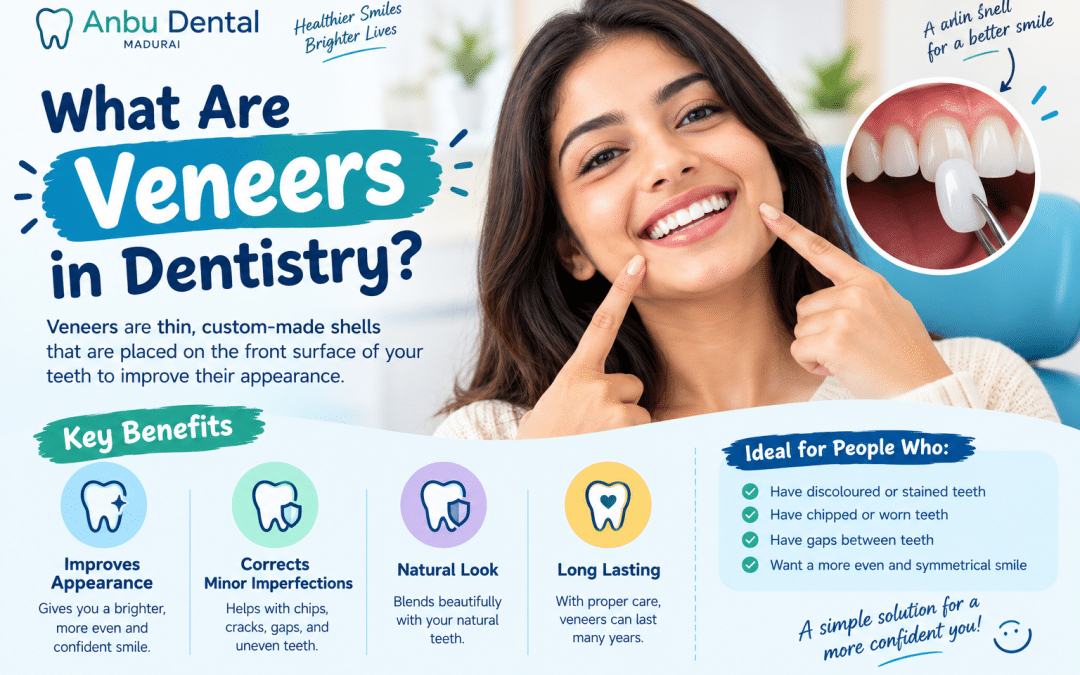
Dental veneers are thin, custom-made shells placed over the front surfaces of teeth to improve their colour, shape, size, and overall appearance. They are designed to blend with your natural teeth and enhance your smile.
Veneers are commonly made from porcelain or composite resin. The choice depends on factors such as the condition of your teeth, desired results, budget, and your dentist’s recommendation.
What Dental Problems Can Veneers Help Improve?
Dental veneers may be recommended for people who want to address certain cosmetic concerns, including:
- Stained or discoloured teeth: For some types of stains that do not respond well to teeth whitening.
- Chipped or worn teeth: To improve the appearance of minor chips or worn edges.
- Uneven tooth shapes: To create a more uniform appearance.
- Small gaps between teeth: To reduce the appearance of certain spaces between teeth.
- Slightly irregular-looking teeth: To improve the visible alignment and symmetry of the smile in suitable cases.
Veneers are primarily a cosmetic treatment. Significant tooth misalignment, bite problems, or extensive dental damage may require other treatments.
What Are the Different Types of Dental Veneers?
There are two commonly used types of veneers.
- Porcelain Veneers
Porcelain veneers are custom-made shells designed to mimic the appearance of natural tooth enamel. They are known for their natural-looking finish and resistance to staining.
Benefits of porcelain veneers:
- Natural-looking colour and appearance.
- Good stain resistance.
- Customised shape and size.
- Can provide long-lasting results with proper care.
Porcelain veneers generally require laboratory fabrication, and some enamel may need to be removed before placement. This makes the procedure irreversible in many cases.
- Composite Veneers
Composite veneers are made using tooth-coloured resin material that is shaped and bonded to the teeth. Depending on the case, the treatment may be completed in a single visit.
Benefits of composite veneers:
- Often more affordable than porcelain veneers.
- May require less tooth preparation in suitable cases.
- Can be repaired if minor damage occurs.
- May provide a quicker cosmetic improvement.
Composite veneers are generally more prone to staining and wear than porcelain veneers and may need maintenance or replacement sooner.
How Is the Dental Veneer Procedure Done?
The veneer procedure typically involves the following steps:
Step 1: Dental Consultation
Your dentist examines your teeth, gums, bite, and overall oral health. You can discuss your smile goals and understand whether veneers are suitable for you.
Step 2: Treatment Planning
The dentist evaluates the tooth shape, colour, and spacing to plan a result that complements your facial features and natural smile.
Step 3: Tooth Preparation
For certain veneers, a small amount of enamel may be removed to create space for the veneer. The amount of preparation depends on the material and your individual case.
Step 4: Veneer Placement
For porcelain veneers, impressions or digital scans may be taken to create customised veneers. Temporary veneers may be provided when necessary. At a later appointment, the dentist checks the fit and appearance before bonding the veneers to the teeth.
Composite veneers may be shaped directly on the teeth and hardened using a special curing light.
Step 5: Final Assessment
Your dentist checks the fit, bite, comfort, and appearance to ensure the veneers function properly.
Are Dental Veneers Painful?
Dental veneer treatment is generally well tolerated. Some patients may experience temporary tooth sensitivity, particularly when enamel preparation is required. Local anaesthesia may be used when necessary to improve comfort during the procedure.
Your dentist will explain the treatment process and discuss any concerns before starting.
How Long Do Dental Veneers Last?
The lifespan of dental veneers depends on the material used, oral hygiene, eating habits, and individual bite conditions.
Porcelain veneers often last around 10–15 years or longer with appropriate care, while composite veneers may require replacement or repair sooner. These are general estimates, not guarantees.
To help maintain your veneers:
- Brush twice daily using a fluoride toothpaste.
- Clean between your teeth every day.
- Avoid biting hard objects such as ice or hard shells.
- Do not use your teeth to open packages.
- Avoid smoking and limit habits that may stain natural teeth or composite restorations.
- Visit your dentist regularly for professional examination.
- Consider a night guard if you grind or clench your teeth.
Are Dental Veneers Suitable for Everyone?
Veneers may not be the best option for every patient. Your dentist will assess your oral health before recommending treatment.
People with untreated tooth decay, gum disease, significant bite problems, or severe teeth grinding may need other treatments first. In some situations, orthodontic treatment, teeth whitening, dental bonding, or crowns may be more appropriate.
It is important to understand that veneers mainly improve the visible appearance of teeth and do not replace the need to maintain healthy teeth and gums.
Dental Veneers vs. Teeth Whitening
Although both treatments can improve the appearance of a smile, they serve different purposes.
Teeth whitening lightens the colour of natural teeth but does not change their shape or repair chips. Veneers can alter the appearance of tooth colour, shape, and size, and may help conceal certain cosmetic imperfections.
The right treatment depends on the underlying concern. A dental consultation can help you determine which option is suitable for your needs.
Enhance Your Smile with Anbu Dental, Madurai
If you are considering dental veneers to improve your smile, professional guidance is an important first step. At Anbu Dental, Madurai, our dental team can assess your teeth, discuss your expectations, and explain suitable cosmetic dentistry options based on your oral health.
Whether you are concerned about stained teeth, minor chips, uneven tooth shapes, or small gaps, a personalised treatment plan can help you make an informed decision about your smile.
Book a dental consultation at Anbu Dental, Madurai, to explore whether dental veneers are right for you.
Frequently Asked Questions (FAQs)
- Do dental veneers look natural?
Yes. Well-designed veneers can closely resemble natural teeth. Their colour, shape, and size are customised to complement your smile.
- Are dental veneers permanent?
Veneers are not necessarily permanent restorations. They eventually require replacement, and porcelain veneers that involve enamel removal are generally irreversible.
- Can veneers fix gaps between teeth?
Veneers may help close small gaps in suitable cases. Larger gaps or gaps caused by significant alignment problems may be better treated with orthodontics.
- Can I eat normally after getting veneers?
Most patients can eat normally after treatment, but it is advisable to avoid biting very hard objects and to follow your dentist’s instructions.
- Are veneers better than crowns?
Neither option is universally better. Veneers cover the front surface of a tooth and are mainly used for cosmetic improvements, whereas crowns cover most or all of the visible tooth and may be recommended when a tooth needs greater structural protection.
- How do I know whether I need veneers?
A dental examination is the best way to determine whether veneers are appropriate. Your dentist can assess your oral health and discuss alternatives based on your needs.