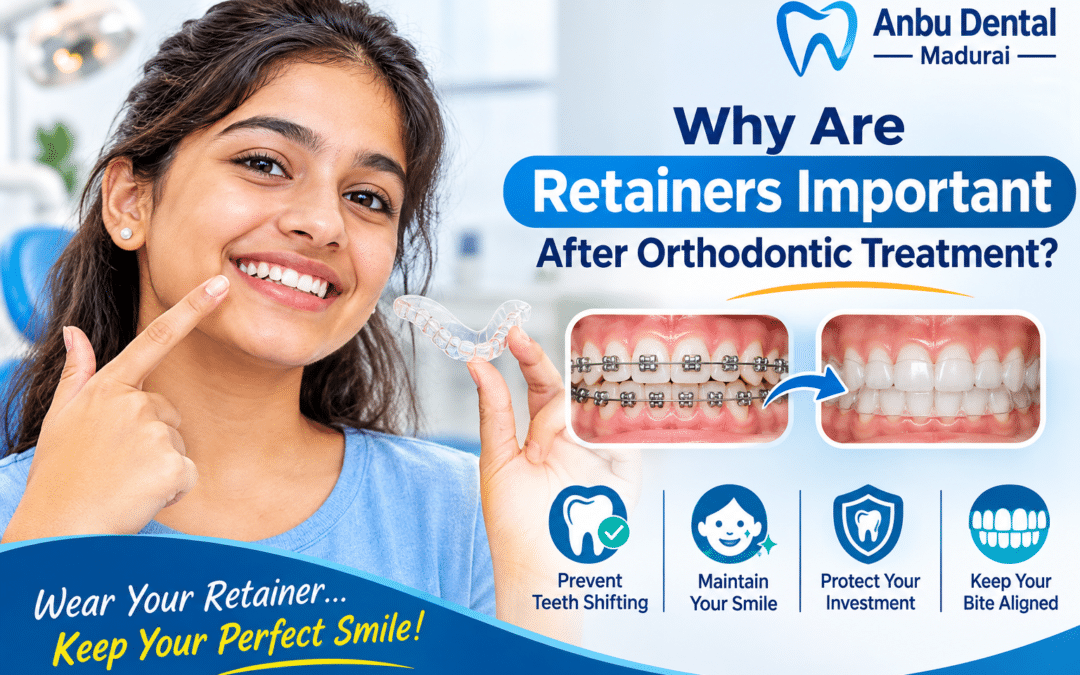
Completing orthodontic treatment is an exciting milestone. After months or even years of wearing braces or undergoing aligner treatment, seeing your teeth properly aligned can be a rewarding experience. However, maintaining that beautiful smile requires continued care even after your braces are removed.
This is where dental retainers play an important role. Retainers help keep your teeth in their corrected positions and prevent them from gradually shifting back to their original alignment.
At Anbu Dental, Madurai, we emphasize the importance of wearing retainers after orthodontic treatment to maintain long-term results and protect your investment in a healthier, straighter smile.
What Are Dental Retainers?
Dental retainers are custom-made orthodontic appliances designed to hold your teeth in their new positions after braces or clear aligner treatment.
During orthodontic treatment, controlled pressure gradually moves the teeth into the desired alignment. Once the braces are removed, the surrounding gums, bones, and periodontal tissues need time to adapt to these changes.
Without proper retention, teeth may gradually move back towards their previous positions. This movement is known as orthodontic relapse.
Retainers help stabilize the teeth while the surrounding supporting tissues adapt to their new positions.
Why Are Retainers Important After Braces?
There are several reasons why wearing retainers after orthodontic treatment is essential.
- Prevents Teeth from Shifting Back
One of the main reasons for wearing retainers is to prevent orthodontic relapse. Teeth have a natural tendency to move throughout life, and they may shift towards their original positions after braces are removed.
Wearing retainers as prescribed by your orthodontist helps maintain the alignment achieved through treatment.
- Maintains Your Beautiful Smile
After completing orthodontic treatment, you naturally want to preserve your new smile. Retainers help maintain the position of your teeth, keeping them properly aligned and supporting the results of your orthodontic treatment.
- Allows Supporting Tissues to Adapt
The gums, periodontal ligaments, and surrounding bone require time to reorganize after tooth movement.
Retainers help stabilize the teeth during this adaptation period, reducing the chances of unwanted movement.
- Protects Your Orthodontic Investment
Braces and aligner treatments require time, commitment, and financial investment. Not wearing retainers as recommended may lead to unwanted tooth movement and, in some cases, the need for additional orthodontic treatment.
Consistent retainer use helps protect the results you have achieved.
- Maintains Your Bite Alignment
Retainers help preserve the corrected relationship between your upper and lower teeth. Maintaining proper alignment can support comfortable biting and chewing.
What Are the Different Types of Dental Retainers?
There are different types of retainers available. Your orthodontist will recommend the most suitable option based on your dental condition and treatment results.
- Removable Retainers
Removable retainers can be taken out while eating, brushing, and cleaning.
Common types include:
- Hawley Retainers: Made with an acrylic base and a metal wire that holds the teeth in position.
- Clear Plastic Retainers: Transparent, custom-made retainers that fit closely over the teeth. They are discreet and commonly preferred for their appearance.
- Fixed or Permanent Retainers
Fixed retainers consist of a thin wire bonded to the back surfaces of the front teeth.
They remain in place and provide continuous retention without requiring the patient to remember to wear them daily.
However, they require careful cleaning and regular dental check-ups to maintain proper oral hygiene.
How Long Should You Wear Retainers After Orthodontic Treatment?
The duration of retainer use varies depending on your orthodontic condition, age, treatment complexity, and the type of retainer prescribed.
Generally:
- Immediately after braces removal: Retainers should be worn according to your orthodontist’s instructions, often full-time initially.
- After the initial phase: Your orthodontist may recommend switching to nighttime wear.
- Long-term maintenance: Many patients benefit from wearing retainers at night indefinitely to maintain their teeth alignment.
Never stop wearing your retainers without consulting your orthodontist.
What Happens If You Stop Wearing Your Retainers?
If you stop wearing your retainers, your teeth may gradually shift out of alignment. This can result in:
- Gaps developing between teeth.
- Crowding or overlapping of teeth.
- Changes in your bite alignment.
- Difficulty fitting your old retainer.
- Possible need for additional orthodontic treatment.
If your retainer feels tight or no longer fits properly, do not force it into position. Consult your orthodontist for an evaluation.
How to Take Care of Your Dental Retainers
Proper retainer maintenance is important for both oral hygiene and appliance durability.
Follow these simple tips:
- Clean your removable retainers regularly using a soft toothbrush and a cleaner recommended by your orthodontist.
- Avoid hot water, as excessive heat can distort plastic retainers.
- Always store removable retainers in their protective case when not in use.
- Avoid wrapping retainers in tissues, as they can easily be misplaced or accidentally discarded.
- Clean carefully around fixed retainers using appropriate flossing tools.
- Attend regular dental check-ups to ensure your retainers fit properly and remain in good condition.
Frequently Asked Questions (FAQs)
- Are retainers compulsory after braces treatment?
Retainers are an essential part of orthodontic treatment. They help maintain the corrected tooth positions and reduce the risk of relapse.
- Can I sleep without wearing my retainers?
You should follow the wearing schedule recommended by your orthodontist. If nighttime wear is prescribed, removing your retainers while sleeping may increase the risk of teeth shifting.
- Can retainers straighten teeth again?
Retainers are primarily designed to maintain tooth alignment, not correct significant tooth movement. If your teeth have shifted considerably, additional orthodontic treatment may be necessary.
- Do retainers need to be replaced?
Yes. Removable retainers may wear out, crack, or lose their fit over time. Fixed retainers may also become loose or damaged. Consult your orthodontist if you notice any changes.
- Are clear retainers better than fixed retainers?
Both options have advantages. Clear retainers are removable and less noticeable, while fixed retainers provide continuous retention. Your orthodontist will recommend the appropriate option based on your dental needs.
Maintain Your Perfect Smile with Proper Retainer Care!
Completing orthodontic treatment is only one part of your journey towards a healthy, confident smile. Wearing retainers consistently is equally important to preserve your results and prevent unwanted tooth movement.
At Anbu Dental, Madurai, we focus on comprehensive orthodontic care and long-term smile maintenance. Our dental team can guide you on choosing the right retainer, maintaining proper oral hygiene, and protecting your orthodontic results.
Book your dental consultation at Anbu Dental, Madurai, and take the next step towards maintaining your beautiful smile!