A root canal treatment (RCT) can save a tooth that has been affected by deep decay, infection, or damage. But completing the root canal is not always the final step. In many cases, placing a dental crown is an important part of protecting the treated tooth and restoring its function.
At Anbu Dental, Madurai, we help patients understand why protecting an RCT-treated tooth is essential for long-term oral health.
What Happens to a Tooth After RCT?
During root canal treatment, the infected or inflamed pulp inside the tooth is removed and the root canals are cleaned, disinfected, and sealed.
Although the treatment removes the infection, the tooth may have already lost a significant amount of its natural structure due to:
- Extensive tooth decay
- Previous fillings
- Cracks or fractures
- Removal of infected tooth structure during treatment
As a result, the remaining tooth may need additional protection against everyday chewing forces.
Why Is a Crown Recommended?
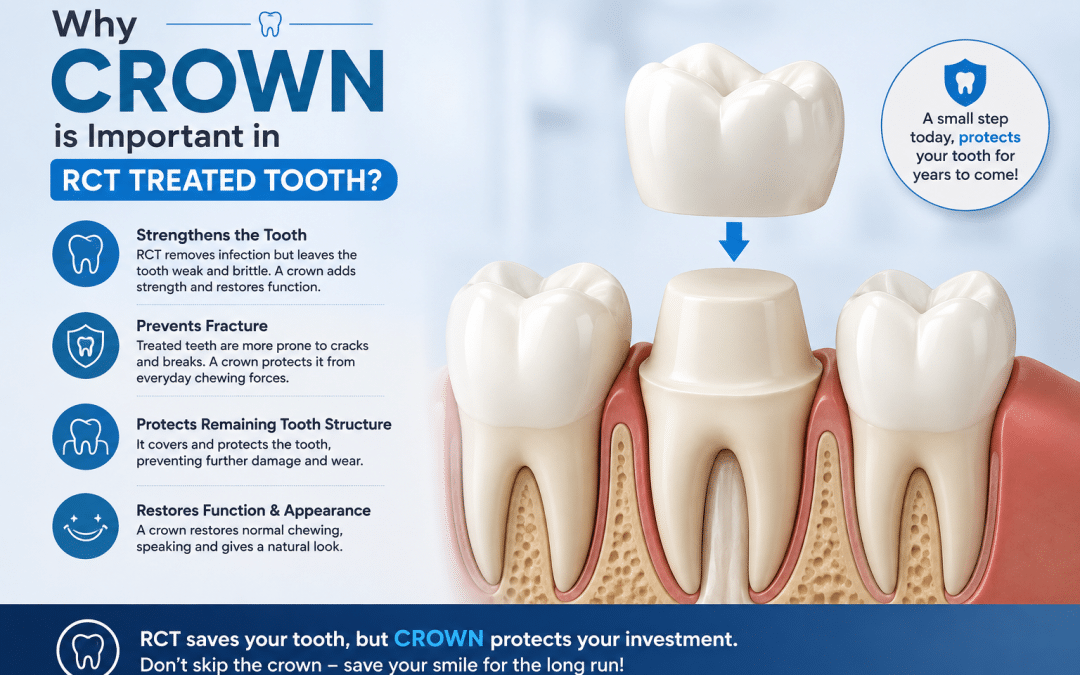
1. It Helps Protect the Tooth from Fracture
A tooth that has undergone RCT, particularly a back tooth, may be more susceptible to fracture because a substantial amount of its structure may have been lost.
A crown covers and protects the remaining tooth structure, helping it withstand normal biting and chewing forces.
2. It Restores the Tooth’s Function
After RCT, the tooth needs to function normally during eating. A properly designed crown restores the tooth’s shape and allows you to chew more comfortably.
3. It Provides Full-Coverage Protection
Unlike a conventional filling, a crown covers much of the visible portion of the tooth. This can provide additional structural support when a large amount of tooth structure has been lost.
4. It Helps Prevent Further Damage
An unprotected, weakened tooth can be more vulnerable to cracks or fractures. In some cases, a severe fracture can make the tooth difficult or impossible to save.
Protecting the tooth with an appropriate restoration can therefore be an important part of maintaining it for the long term.
5. It Restores the Appearance of the Tooth
Crowns can also improve the appearance of a heavily restored or discoloured tooth. Modern crowns are available in tooth-coloured materials that can be designed to blend naturally with surrounding teeth.
Does Every Root Canal-Treated Tooth Need a Crown?
Not necessarily.
The need for a crown depends on several factors, including:
- Which tooth has received RCT
- How much natural tooth structure remains
- The size of the existing restoration
- The tooth’s location and chewing load
- Whether the tooth has cracks or other structural damage
Back teeth such as premolars and molars commonly require full-coverage protection after RCT because they experience significant chewing forces.
Your dentist can examine the tooth and recommend the most appropriate restoration based on its condition.
What Happens If You Delay the Crown?
After RCT, it is important to follow your dentist’s recommendation regarding the final restoration.
Delaying the crown on a tooth that needs full-coverage protection may leave it vulnerable to fracture. A fractured tooth can sometimes require more extensive treatment, and in severe cases, the tooth may not be restorable.
Until the final restoration is placed, follow your dentist’s instructions and avoid putting excessive force on the treated tooth.
How Long Can an RCT-Treated Tooth Last?
A root canal-treated tooth can function for many years when it receives appropriate restoration and care. Its long-term outlook depends on factors such as the quality of the root canal treatment, the amount of remaining tooth structure, the final restoration, oral hygiene, and regular dental care.
A crown is not simply a cosmetic addition—it can be an important part of protecting a structurally compromised tooth.
Protect Your Root Canal-Treated Tooth at Anbu Dental, Madurai
If you have recently undergone root canal treatment or have an older RCT-treated tooth without a crown, it is worth having it evaluated by a dentist.
At Anbu Dental, Madurai, our dental team can assess the condition of your tooth and recommend the appropriate restoration to help protect your smile.
A root canal can save the tooth. A well-planned restoration helps protect it for the years ahead.
Anbu Dental, Madurai
Book a dental consultation to find out whether your RCT-treated tooth needs a crown.